 Add to Chrome
 Add to Firefox
 Add to Edge
HELIX: Hybrid Encoding with Learnable Identity and Cross-dimensional Synthesis for Time Series Imputation
May 04, 2026
Time series imputation benefits from leveraging cross-feature correlations, yet existing attention-based methods re-discover feature relationships at each layer, lacking persistent anchors to maintain consistent representations. To address this, we propose HELIX, which assigns each feature a learnable feature identity, a persistent embedding that captures intrinsic semantic properties throughout the network. Unlike graph-based methods that rely on predefined topology and assume homogeneous spatial relationships, HELIX learns arbitrary feature dependencies end-to-end from temporal co-variation, naturally handling datasets where features mix spatial locations with semantic variables. Integrated with hybrid temporal-feature attention, HELIX achieves the state-of-the-art performance, surpassing all 16 baselines on 5 public datasets across 21 experimental settings in our evaluation. Furthermore, our mechanistic analysis reveals that HELIX aligns learned feature identities and dependencies with latent physical and semantic structure progressively across layers, demonstrating that it more effectively translates cross-feature structure into imputation accuracy.

End-to-End Learning for Partially-Observed Time Series with PyPOTS
Apr 27, 2026Partially-observed time series (POTS) is ubiquitous in real-world applications, yet most existing toolchains separate missing-value handling from downstream learning, which limits reproducibility and overall performance. This tutorial introduces PyPOTS, an open-source Python ecosystem for end-to-end data mining and machine learning on POTS. We present practical workflows spanning missingness simulation, data preprocessing, model training, and evaluation across core tasks, including imputation, forecasting, classification, clustering, and anomaly detection. The tutorial consists of two parts: Part I emphasizes hands-on application for practitioners through unified APIs and benchmark-oriented experiments. Part II targets developers and researchers, focusing on extending PyPOTS with custom models, domain-specific constraints, and contribution-ready engineering practices. Participants will gain both conceptual understanding and implementation experience for building robust, transparent, and reusable POTS pipelines in research and production settings. PyPOTS is publicly available at https://github.com/WenjieDu/PyPOTS
SHAPE: Structure-aware Hierarchical Unsupervised Domain Adaptation with Plausibility Evaluation for Medical Image Segmentation
Mar 23, 2026Unsupervised Domain Adaptation (UDA) is essential for deploying medical segmentation models across diverse clinical environments. Existing methods are fundamentally limited, suffering from semantically unaware feature alignment that results in poor distributional fidelity and from pseudo-label validation that disregards global anatomical constraints, thus failing to prevent the formation of globally implausible structures. To address these issues, we propose SHAPE (Structure-aware Hierarchical Unsupervised Domain Adaptation with Plausibility Evaluation), a framework that reframes adaptation towards global anatomical plausibility. Built on a DINOv3 foundation, its Hierarchical Feature Modulation (HFM) module first generates features with both high fidelity and class-awareness. This shifts the core challenge to robustly validating pseudo-labels. To augment conventional pixel-level validation, we introduce Hypergraph Plausibility Estimation (HPE), which leverages hypergraphs to assess the global anatomical plausibility that standard graphs cannot capture. This is complemented by Structural Anomaly Pruning (SAP) to purge remaining artifacts via cross-view stability. SHAPE significantly outperforms prior methods on cardiac and abdominal cross-modality benchmarks, achieving state-of-the-art average Dice scores of 90.08% (MRI->CT) and 78.51% (CT->MRI) on cardiac data, and 87.48% (MRI->CT) and 86.89% (CT->MRI) on abdominal data. The code is available at https://github.com/BioMedIA-repo/SHAPE.
LVOmniBench: Pioneering Long Audio-Video Understanding Evaluation for Omnimodal LLMs
Mar 19, 2026Recent advancements in omnimodal large language models (OmniLLMs) have significantly improved the comprehension of audio and video inputs. However, current evaluations primarily focus on short audio and video clips ranging from 10 seconds to 5 minutes, failing to reflect the demands of real-world applications, where videos typically run for tens of minutes. To address this critical gap, we introduce LVOmniBench, a new benchmark designed specifically for the cross-modal comprehension of long-form audio and video. This dataset comprises high-quality videos sourced from open platforms that feature rich audio-visual dynamics. Through rigorous manual selection and annotation, LVOmniBench comprises 275 videos, ranging in duration from 10 to 90 minutes, and 1,014 question-answer (QA) pairs. LVOmniBench aims to rigorously evaluate the capabilities of OmniLLMs across domains, including long-term memory, temporal localization, fine-grained understanding, and multimodal perception. Our extensive evaluation reveals that current OmniLLMs encounter significant challenges when processing extended audio-visual inputs. Open-source models generally achieve accuracies below 35%, whereas the Gemini 3 Pro reaches a peak accuracy of approximately 65%. We anticipate that this dataset, along with our empirical findings, will stimulate further research and the development of advanced models capable of resolving complex cross-modal understanding problems within long-form audio-visual contexts.
Refold: Refining Protein Inverse Folding with Efficient Structural Matching and Fusion
Mar 15, 2026Protein inverse folding aims to design an amino acid sequence that will fold into a given backbone structure, serving as a central task in protein design. Two main paradigms have been widely explored. Template-based methods exploit database-derived structural priors and can achieve high local precision when close structural neighbors are available, but their dependence on database coverage and match quality often degrades performance on out-of-distribution (OOD) targets. Deep learning approaches, in contrast, learn general structure-to-sequence regularities and usually generalize better to new backbones. However, they struggle to capture fine-grained local structure, which can cause uncertain residue predictions and missed local motifs in ambiguous regions. We introduce Refold, a novel framework that synergistically integrates the strengths of database-derived structural priors and deep learning prediction to enhance inverse folding. Refold obtains structural priors from matched neighbors and fuses them with model predictions to refine residue probabilities. In practice, low-quality neighbors can introduce noise, potentially degrading model performance. We address this issue with a Dynamic Utility Gate that controls prior injection and falls back to the base prediction when the priors are untrustworthy. Comprehensive evaluations on standard benchmarks demonstrate that Refold achieves state-of-the-art native sequence recovery of 0.63 on both CATH 4.2 and CATH 4.3. Also, analysis indicates that Refold delivers larger gains on high-uncertainty regions, reflecting the complementarity between structural priors and deep learning predictions.
Environment-Aware Code Generation: How far are We?
Jan 18, 2026Recent progress in large language models (LLMs) has improved code generation, but most evaluations still test isolated, small-scale code (e.g., a single function) under default or unspecified software environments. As a result, it is unclear whether LLMs can reliably generate executable code tailored to a user's specific environment. We present the first systematic study of Environment-Aware Code Generation (EACG), where generated code must be functionally correct and directly executable under arbitrary software configurations. To enable realistic evaluation, we introduce VersiBCB, a benchmark that is multi-package, execution-verified, and deprecation-aware, capturing complex and evolving environments that prior datasets often overlook. Using VersiBCB, we investigate three complementary adaptation axes: data, parameters, and cache, and develop representative strategies for each. Our results show that current LLMs struggle with environment-specific code generation, while our adaptations improve environment compatibility and executability. These findings highlight key challenges and opportunities for deploying LLMs in practical software engineering workflows.
Interleaved Tool-Call Reasoning for Protein Function Understanding
Jan 07, 2026Recent advances in large language models (LLMs) have highlighted the effectiveness of chain-of-thought reasoning in symbolic domains such as mathematics and programming. However, our study shows that directly transferring such text-based reasoning paradigms to protein function understanding is ineffective: reinforcement learning mainly amplifies superficial keyword patterns while failing to introduce new biological knowledge, resulting in limited generalization. We argue that protein function prediction is a knowledge-intensive scientific task that fundamentally relies on external biological priors and computational tools rather than purely internal reasoning. To address this gap, we propose PFUA, a tool-augmented protein reasoning agent that unifies problem decomposition, tool invocation, and grounded answer generation. Instead of relying on long unconstrained reasoning traces, PFUA integrates domain-specific tools to produce verifiable intermediate evidence. Experiments on four benchmarks demonstrate that PFUA consistently outperforms text-only reasoning models with an average performance improvement of 103%.
OmniAgent: Audio-Guided Active Perception Agent for Omnimodal Audio-Video Understanding
Dec 29, 2025Omnimodal large language models have made significant strides in unifying audio and visual modalities; however, they often lack the fine-grained cross-modal understanding and have difficulty with multimodal alignment. To address these limitations, we introduce OmniAgent, a fully audio-guided active perception agent that dynamically orchestrates specialized tools to achieve more fine-grained audio-visual reasoning. Unlike previous works that rely on rigid, static workflows and dense frame-captioning, this paper demonstrates a paradigm shift from passive response generation to active multimodal inquiry. OmniAgent employs dynamic planning to autonomously orchestrate tool invocation on demand, strategically concentrating perceptual attention on task-relevant cues. Central to our approach is a novel coarse-to-fine audio-guided perception paradigm, which leverages audio cues to localize temporal events and guide subsequent reasoning. Extensive empirical evaluations on three audio-video understanding benchmarks demonstrate that OmniAgent achieves state-of-the-art performance, surpassing leading open-source and proprietary models by substantial margins of 10% - 20% accuracy.
LLM-Explorer: Towards Efficient and Affordable LLM-based Exploration for Mobile Apps
May 15, 2025Large language models (LLMs) have opened new opportunities for automated mobile app exploration, an important and challenging problem that used to suffer from the difficulty of generating meaningful UI interactions. However, existing LLM-based exploration approaches rely heavily on LLMs to generate actions in almost every step, leading to a huge cost of token fees and computational resources. We argue that such extensive usage of LLMs is neither necessary nor effective, since many actions during exploration do not require, or may even be biased by the abilities of LLMs. Further, based on the insight that a precise and compact knowledge plays the central role for effective exploration, we introduce LLM-Explorer, a new exploration agent designed for efficiency and affordability. LLM-Explorer uses LLMs primarily for maintaining the knowledge instead of generating actions, and knowledge is used to guide action generation in a LLM-less manner. Based on a comparison with 5 strong baselines on 20 typical apps, LLM-Explorer was able to achieve the fastest and highest coverage among all automated app explorers, with over 148x lower cost than the state-of-the-art LLM-based approach.
EDBench: Large-Scale Electron Density Data for Molecular Modeling
May 14, 2025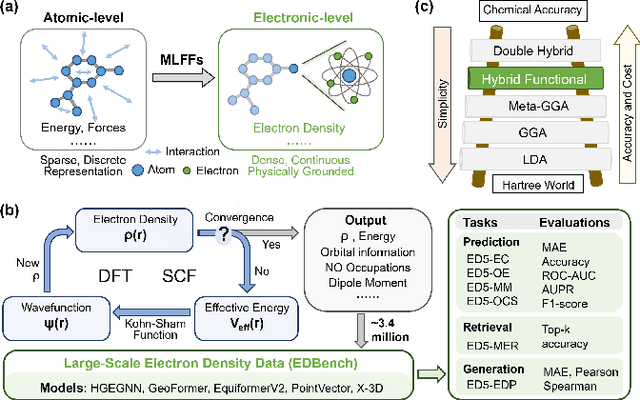
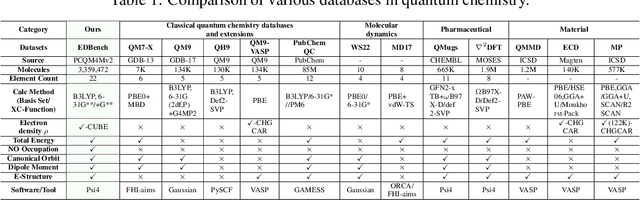

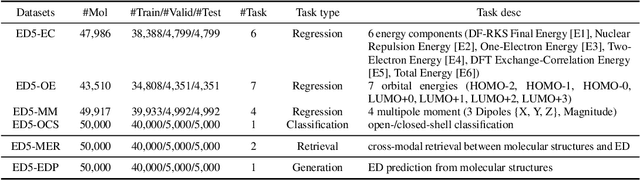
Existing molecular machine learning force fields (MLFFs) generally focus on the learning of atoms, molecules, and simple quantum chemical properties (such as energy and force), but ignore the importance of electron density (ED) $\rho(r)$ in accurately understanding molecular force fields (MFFs). ED describes the probability of finding electrons at specific locations around atoms or molecules, which uniquely determines all ground state properties (such as energy, molecular structure, etc.) of interactive multi-particle systems according to the Hohenberg-Kohn theorem. However, the calculation of ED relies on the time-consuming first-principles density functional theory (DFT) which leads to the lack of large-scale ED data and limits its application in MLFFs. In this paper, we introduce EDBench, a large-scale, high-quality dataset of ED designed to advance learning-based research at the electronic scale. Built upon the PCQM4Mv2, EDBench provides accurate ED data, covering 3.3 million molecules. To comprehensively evaluate the ability of models to understand and utilize electronic information, we design a suite of ED-centric benchmark tasks spanning prediction, retrieval, and generation. Our evaluation on several state-of-the-art methods demonstrates that learning from EDBench is not only feasible but also achieves high accuracy. Moreover, we show that learning-based method can efficiently calculate ED with comparable precision while significantly reducing the computational cost relative to traditional DFT calculations. All data and benchmarks from EDBench will be freely available, laying a robust foundation for ED-driven drug discovery and materials science.